
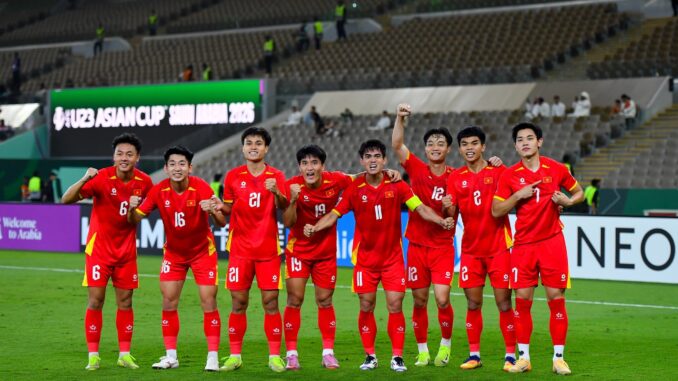
Saudi Arabia, 17 January 2026 – After sweeping the group stage, U23 Vietnam continued their impressive run at the AFC U23 Asian Cup 2026 by eliminating U23 UAE in the knockout round, showcasing a completely different but highly effective approach that underlined their clear tactical evolution.
After three consecutive wins in the group stage, including a statement victory over hosts U23 Saudi Arabia, U23 Vietnam earned considerable respect from their rivals at the AFC U23 Asian Cup 2026. That respect was evident in the quarter-final, where U23 United Arab Emirates adopted an extremely cautious approach, prioritising defensive solidity over their usual attacking ambition.
Whenever possession was lost, UAE’s players immediately retreated deep into their own half to shield goalkeeper Tawhid, forming a compact defensive block. The West Asian side were visibly wary of pushing numbers forward, clearly conscious of Vietnam’s pace, movement, and ability to strike quickly in transition. Their game plan reflected an understanding that they were facing a far more formidable opponent than in previous meetings.
In response, head coach Kim Sang-sik made decisive tactical adjustments. The knockout nature of the match allowed U23 Vietnam to embrace a more pragmatic yet intelligent style, without sacrificing control or initiative. Rather than rushing play, Vietnam dominated possession for large periods, circulated the ball calmly, and completely outperformed UAE in the number of corner kicks earned. The flanks were particularly well managed, as Vietnam successfully neutralised UAE’s physically imposing African-origin attackers.
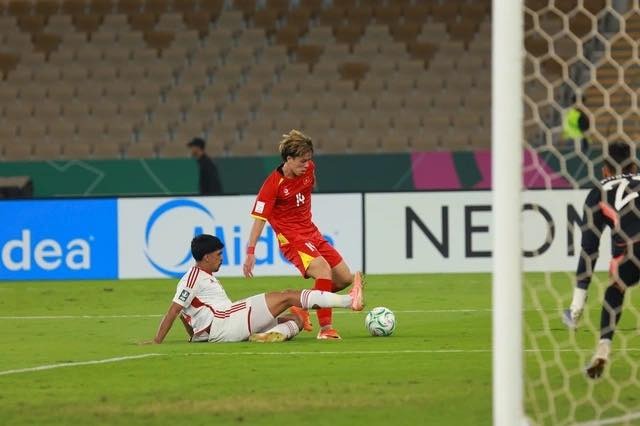
Compared to earlier matches, U23 Vietnam played with greater composure and discipline. Despite facing a strong opponent, efficiency remained intact. A notable feature was captain Khuat Van Khang, who operated on the left side and provided excellent balance between attacking support and defensive responsibility, helping the team maintain structure throughout the game.
In a bold selection move, U23 Vietnam started the quarter-final with a front three of Le Phat, Ngoc My, and Le Viktor—players who were not regular starters during SEA Games 33. This highlighted Kim Sang-sik’s willingness to adapt at continental level, where the attacking unit saw the most rotation. Le Viktor’s wide-ranging movement, Ngoc My’s physical presence, and Le Phat’s speed were all carefully chosen to wear down the UAE defence over time.
Later in the second half and during extra time, Anh Quan was introduced in an unconventional role. Instead of playing as a traditional left-back, he was deployed higher up on the right flank. With sharper finishing and a bit more luck, the PVF-CAND defender could have scored from two or three clear chances. More importantly, his defensive instincts helped disrupt UAE’s wide attacks from an advanced position, effectively shutting down their left side during the closing stages of regulation time and both extra-time periods.
What stood out most after these adjustments was Vietnam’s confidence in controlling the game. The red shirts patiently recycled possession, forcing the white-clad UAE players into prolonged defensive phases. This scenario would have been hard to imagine before the tournament, given Vietnam’s historical tendency to sit deep and defend against physically superior West Asian teams.
Instead, U23 Vietnam imposed themselves, forcing UAE to chase the game twice over 90 minutes. This was a clear sign of transformation. After asserting dominance in Southeast Asia, U23 Vietnam have now demonstrated a genuine evolution—one that allows them not only to resist pressure at continental level, but to dictate play with maturity, intelligence, and belief.
Leave a Reply