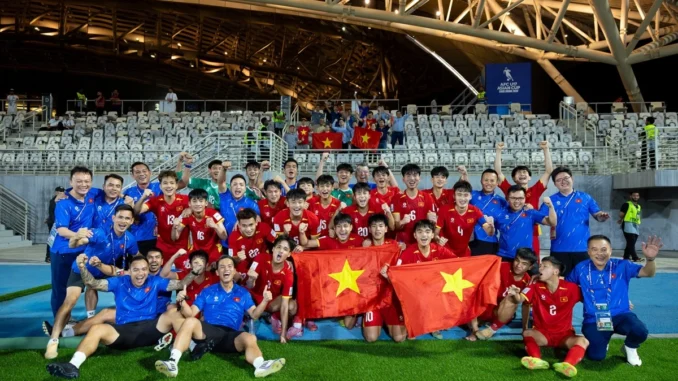
Saudi Arabia, 14 May 2026 – Vietnam’s U17 national team booked a historic place at the FIFA U17 World Cup 2026 after finishing top of Group A and advancing to the quarter-finals of the AFC U17 Asian Cup 2026. But this success was never the result of a single tournament. It was the outcome of years of patient investment, long-term planning, and a football philosophy built on continuity and development.
What stands out most is that T&T Group rarely sought attention for its role in the journey. There were no loud declarations or constant headlines highlighting its contributions. Yet the fingerprints of the Hanoi-based football system could clearly be seen throughout the team’s structure and performances.
In many ways, this is perhaps the most sustainable way to contribute to Vietnamese football: investing in people, investing in systems, and waiting patiently for the results to arrive.
Vietnam’s World Cup qualification was naturally the collective achievement of multiple academies, clubs, coaches, and a talented generation of young players. Development centers such as PVF Football Academy, Viettel FC, Song Lam Nghe An, and Hanoi FC all played important roles. However, a closer look at coach Cristiano Roland’s squad reveals the strong influence of the Hanoi T&T youth system.
Hanoi T&T contributed six players to the national team — the joint-highest alongside PVF. They included goalkeeper Chu Ba Huan, defenders Tran Hoang Viet and Nguyen Khac Minh Duc, midfielders Chu Ngoc Nguyen Luc and Dao Quy Vuong, as well as striker Tran Manh Quan. Viettel, meanwhile, provided four players.
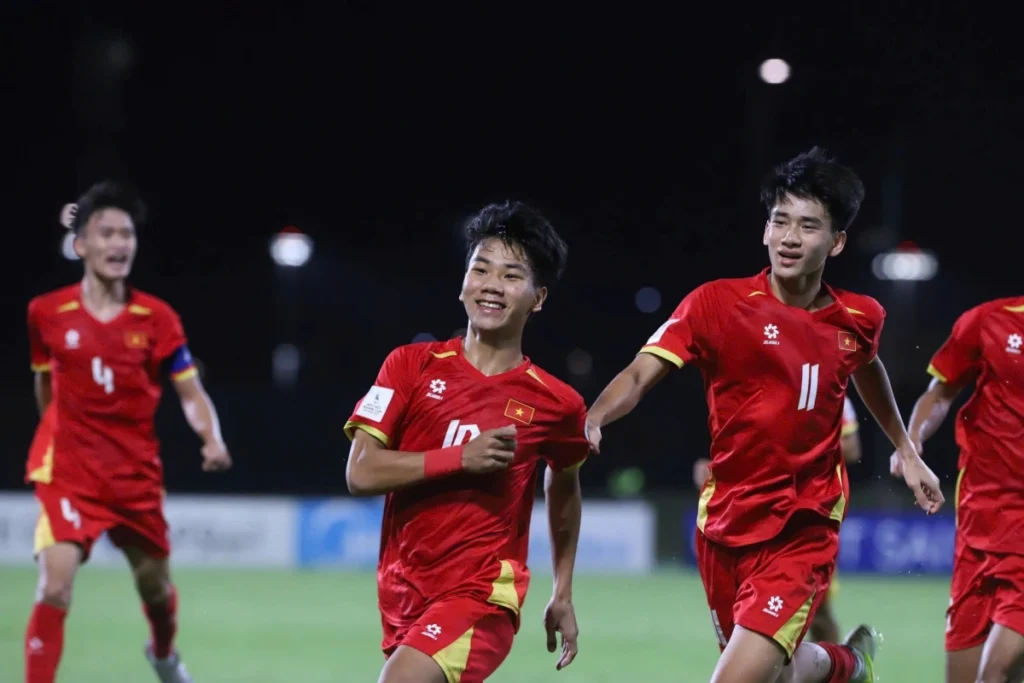
Their impact was especially visible in Vietnam’s dramatic 3-2 victory over United Arab Emirates, the decisive match that secured the World Cup berth. Four Hanoi T&T players featured in that game, with Nguyen Luc emerging as one of the standout performers. His superb free-kick equalizer sparked Vietnam’s comeback and proved to be a turning point. Moments later, he also initiated the attacking move that led to Vietnam taking a 2-1 lead. These contributions showed that the players were not merely squad members, but key tactical pieces within the team’s system.
Less discussed, however, was the silent support from Mr.Hien and T&T Group behind the scenes. Throughout the past two years, the company allowed the U17 coaching staff to focus almost entirely on national team duties despite long training camps and extended absences from club responsibilities.
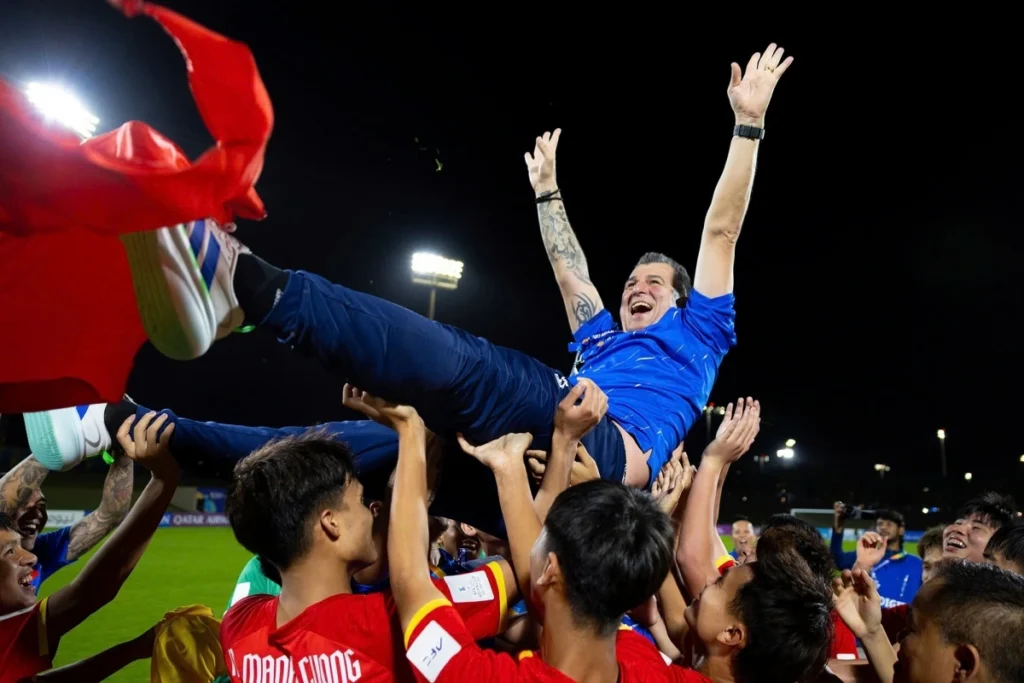
Cristiano Roland and assistants Nguyen Dai Dong and Le Sy Phuong are all products of the Hanoi T&T youth structure. Roland and Nguyen Dai Dong were even directly responsible for the club’s U19 team, a crucial stage in player development. Under Vietnamese professional football regulations, clubs are still responsible for paying their coaches while they serve national teams. For a foreign coach like Roland, whose salary is considerably high, this represented a major long-term investment from T&T Group.
This type of contribution rarely appears on the scoreboard. It cannot be measured by goals or trophies, but it forms the foundation of sustainable success. Without support from the parent club, it would have been difficult for a young coach to fully implement his football philosophy with the national team. Vietnam U17’s success therefore reflects not only Roland’s tactical work, but also T&T’s willingness to prioritize the long-term future of Vietnamese football over immediate club interests.
Importantly, Hanoi FC and T&T are not simply developing young players. They are building a football ecosystem based on continuity — nurturing players, educating coaches, shaping identity, and maintaining long-term loyalty within the club.
The recent celebrations honoring Nguyen Van Quyet for 350 appearances and Do Hung Dung for 300 appearances reflected that philosophy perfectly. Those ceremonies were not merely symbolic tributes, but messages about loyalty, identity, and life after football.
In a football environment where many Vietnamese clubs still operate with short-term thinking, Hanoi FC has positioned players as long-term strategic assets. Do Hung Dung’s career perfectly represents that vision. Rising through the Hanoi T&T academy system, he became a leader through consistency, intelligence, and tactical discipline. Alongside Nguyen Van Quyet, he helped preserve and pass down the club’s identity across generations.
That continuity is now visible in the U17 national team. Cristiano Roland did not build a competitive side overnight. He progressed through the Hanoi T&T youth system, coaching younger age groups before being entrusted with Vietnam U17. More importantly, both the coach and the players were raised within the same “football language,” allowing the team to develop cohesion much faster at international level.
That is why Vietnam U17 under Roland could press collectively, maintain strong defensive structure, stay calm after conceding goals, and compete tactically against physically stronger opponents. Those qualities are never created in just a few months. They are the result of a long-term football culture built patiently over many years.
VSN/RPT
Leave a Reply